
Rutba Media FileServer
Store masters only. Resize on request. Then, if you want it, add an asset index, accounts, versions, collections and AI-generated metadata. Each layer is optional and gated on its own configuration, and none of them changes how the origin behaves when it is off.
Most media stacks store far more than they serve
The conventional approach generates every thumbnail, small, medium and large variant at upload time. In the library that prompted this project, 5,428 originals had become roughly 30,000 files and 4.9 GB. Most of those variants were never requested, all of them stayed on disk forever, and the whole set needing a re-render every time the design changed.
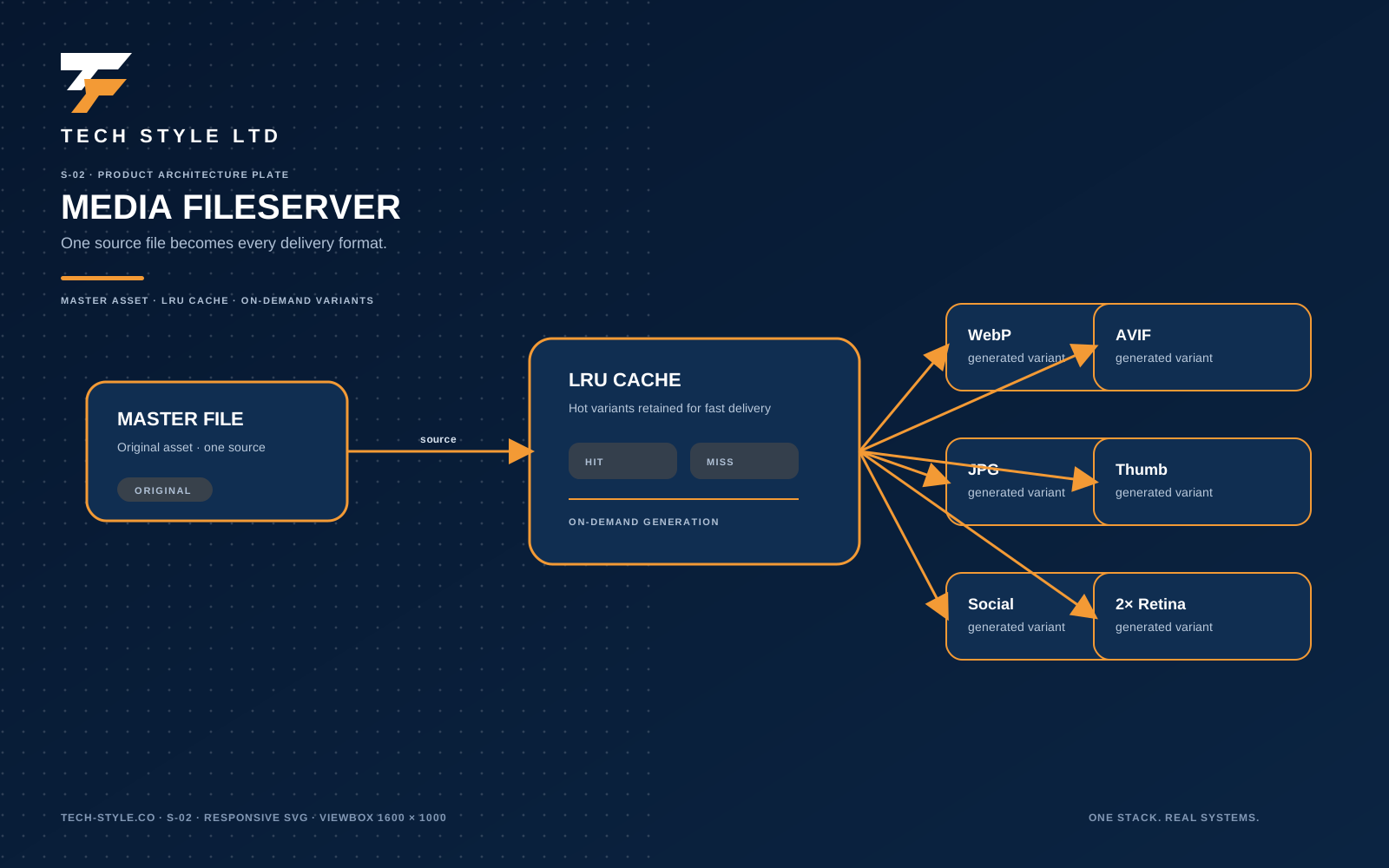
Rutba keeps one thing: the master. Variants are produced when a browser actually asks for them, served, and cached. When the cache hits its ceiling it evicts the least recently used entries down to about 80% and carries on. Change your breakpoints and the old variants simply age out.
It runs in production as the origin for images.trustlist.uk, a directory of vendor logos, and as a separate instance for images.rutba.pk, which holds a retail shop's older product images. In October 2026 it learned to answer before its variant cache index is warm (the first answer over 150,000 cached files fell from 17.7 seconds to 0.9), and an unreadable master is now served unresized instead of stopping the process.
- Stored
- Master files only
- Variants
- Generated on request, cached with LRU
- Default cache cap
- 1 GiB, configurable
- Drop-in for
- Strapi upload provider
Off means unchanged
The governing rule of the codebase: a feature whose backend isn't configured must not alter existing behaviour. No database and it is byte-for-byte the original origin. No ffmpeg and videos simply stream. No API key and there is no AI at all.
Origin: always on
Masters, on-request resizing, the LRU variant cache, Range streaming, multi-volume storage, origin pull-through and clustering. No database required, no build step.
No dependencies to configure
Platform: add MySQL
A complete asset index, a background job queue, accounts with roles and MFA, versions, folders, collections, custom metadata, sharing, WebDAV, quotas, trash and audit, plus a web console. Schema created on first boot.
Gated on DB_HOST
AI: add an API key
Machine-generated tags, captions, alt text, detected text and document summaries through the Claude API, with an optional hard monthly budget and human review before anything counts as a real tag.
Gated on ANTHROPIC_API_KEY
What it does on the way out
Transformations are expressed as query parameters, so a front end can ask for exactly the render it needs.
On-demand resize
Resize through Sharp with w and h in pixels, capped by MAX_DIM (4000 by default). Never upscales; aspect ratio preserved.
Fit modes
inside (default), cover, contain, outside or fill, the same vocabulary Sharp uses, passed straight through.
Format conversion
Request jpeg, png, webp, avif or auto (which honours the browser's Accept header), with quality from 1 to 100 (default 80).
Strapi variant prefixes
Drop-in for existing URLs: thumbnail (245), xsmall (64), small (500), medium (750), large (1000), xlarge (1920), remappable via VARIANTS.
Extension swap
The requested extension is a hint. A request for small_x.webp resolves to master x.jpg and keeps the master's format. Use ?fm= to convert deliberately.
Video poster frames
?poster or ?thumb returns a still frame as an image, with w, h, fm, q and t=<seconds> for the timestamp, cached like any variant.
On-demand transcoding
?transcode=<height> produces H.264/AAC MP4 between 144p and 2160p. Without an ffmpeg binary the original streams instead, and the feature is simply off.
HTTP range streaming
Video, audio, SVG and other non-raster files stream straight from the master store with Range support, so viewers can seek without downloading the whole file.
What it does with what it keeps
Variant cache with a ceiling
Capped by CACHE_MAX_BYTES (1 GiB by default). Every cache hit touches the file, so eviction down to ~80% is a true least-recently-used decision rather than an age heuristic.
Multi-volume masters
Spread masters across directories or mounts, any of which can be read-only. Reads search every volume, so a master on any mount is served and resized transparently.
Placement policies
free writes to the volume with most space, fill to the first with room, route follows prefix rules such as archive/=archive. Existing masters are always replaced in place.
Origin pull-through
A missing master is fetched from an allow-list of base URLs and persisted locally, then served at the requested size, which turns a migration into something lazy rather than a big-bang copy.
Clustering
A fresh upload fans out to eligible peers; a node missing a master asks its peers before reaching for an origin. Replicated writes are marked so receivers don't fan them out again, so nothing loops.
Public / private zones
Each node is public or private. A public-facing node never replicates, accepts or serves a private master, so a LAN node can push its public uploads up while private ones stay inside.
Traversal protection
Path-traversal guards on every read, origin fetches restricted to configured base URLs, and node-to-node traffic authenticated with a secret separate from the upload token.
Concurrency de-duplication
Simultaneous requests for the same uncached variant collapse into a single render instead of stampeding the CPU.
Cache & CORS headers
Immutable Cache-Control on variants, configurable CORS, and HEAD, OPTIONS and /_health for anything sitting in front of it.
Add a database, get an asset manager
Point the server at MySQL and a managed platform switches on over the same masters. The schema is created automatically on first boot, and every part of it is inert again the moment the database goes away.
Index & background work
A row for every master
Rows are keyed by path_hash (the sha256 of the full path) and record which volume holds the bytes, so a read looks the volume up instead of probing each one.
Scan & reconcile
Files that arrived by rsync, restore or a mounted volume are invisible until scanned. A scan indexes unknown masters, refreshes drifted rows, and marks vanished ones missing. It never deletes them, because the row may carry tags, shares and comments.
Resumable, rate-limited
A killed scan continues from its recorded progress rather than starting over, and a files-per-second limit keeps reconciling a large library from starving live requests.
One job queue
Scans, metadata extraction, enrichment and bulk operations all run as jobs. Workers claim under a lease so a crash returns the job; duplicates collapse, so "scan now" clicked five times is one scan.
Accounts & access
Accounts & RBAC
scrypt-hashed passwords, roles and permission predicates, and sessions that die on logout, expiry, password change, role revocation or account disable.
TOTP two-factor
Standard RFC 6238, so any authenticator app works. Nothing switches on until a working code proves the app is really configured, and ten single-use recovery codes are issued at that moment.
Login throttling
Failures counted per account and per IP over a sliding window, locking from the last attempt. A missing MFA code deliberately isn't counted: the password held, and locking someone out for fumbling a 30-second code is self-inflicted denial of service.
API tokens
The credential for scripts, CI and WebDAV. The plaintext is shown once and only its hash is stored.
Read authorisation
public, mixed or private. A caller is admitted by a cluster secret, an upload token, a session or API token, or by a share link, which is itself the explicit grant.
Safe by construction
The last active admin cannot be disabled, demoted or deleted, and deleting a user never deletes files. Ownership is orphaned or reassigned, as you choose.
Managing the library
Versions
An overwrite moves the outgoing copy aside before the new one lands, stored outside every served volume. Restoring retains the current bytes first, so a restore is itself undoable. Retention is capped by count and optionally age.
Folders & collections
Folders are real rows that can be renamed or moved as a subtree. Collections cut across paths, for a campaign, a client or a release. An asset lives in one folder and any number of collections.
Custom metadata
Define your own fields (text, number, date, enum, multi-select, boolean), set them per asset, and filter on them alongside EXIF and tags. Values are stored in the column their type deserves, so a date filter is a date comparison.
Named renditions
?rendition=web-hero instead of a memorised query string. Retune the definition later and every URL downstream teams shipped follows; an explicit parameter still wins.
Bulk operations
Tag, collect, delete, re-extract or enrich everything matching a filter, as one job. The filter is built by the same code that powers the file listing, so the set you previewed is exactly the set that gets touched.
Comments
Threaded per asset and resolvable. Posting notifies the owner and everyone already in the thread, and nobody else. A feed that includes the whole installation is useless within a week.
Share links
Public links with view or forced-download, optional password, expiry and a download cap enforced atomically. Every serve is counted and audited; revoke instantly.
Trash & recovery
Deletes move the master to a trash area outside the served volumes and mark the row, ready to restore, purge or empty. Without a database, delete unlinks exactly as it always did.
Duplicate detection
Every upload is hashed as it streams, so duplicate groups and the total reclaimable bytes come for free, with no extra disk read.
Storage quotas
Per-user caps checked against Content-Length before the body is stored, with a post-write backstop that rolls the file back so it is never served, replicated or indexed.
WebDAV mount
Mount the whole store, across every volume, as a network drive from Windows, macOS, rclone or davfs2. A DAV upload is indistinguishable from an API upload.
Audit trail
Master writes, logins, share access and administrative changes recorded, so you can answer who did what and when.
/_ui/: file browser and search, drag-and-drop bulk upload, previews with EXIF and video metadata, tags as chips, duplicates, trash, shares, users and jobs, served as a plain SPA. Every action it takes is a documented call on the JSON control plane, so anything you can click you can script.
Metadata a machine wrote, and a person approved
With an API key configured, assets get generated tags, captions, alt text, detected text and document summaries through the Claude API. All of it is metadata, and a master is never modified.
Machine tags are not human tags
Suggestions land in their own table, never in the human tag set. They become real tags only when somebody promotes them, which is an explicit and audited act, and a rejected suggestion stays rejected, so re-running enrichment never resurrects it.
Every row records the model and the prompt version that produced it. A bad prompt is therefore revocable rather than an archaeology project, and a re-run is auditable.
A refusal, a malformed response or an exhausted budget is recorded as a result rather than retried. It shows up for review instead of burning four more attempts and four more dollars against the same asset.
| Lever | Why it matters |
|---|---|
| Send a resized variant | Images bill by area. The origin already generates variants, so enrichment uses a bounded one (1568px by default) rather than a 4000px master. That is the single biggest saving. |
| Cache the instruction prefix | The taxonomy and output rules are identical on every call, so they sit before the cache breakpoint and only the image varies. |
| Batch the backfill | Enriching an existing library submits a message batch at half price, skipping assets already done. It is safe to re-run, and it resumes where it stopped. |
| Hard monthly ceiling | Set a monthly budget and it is checked before every call, batches included, so spending stops at the limit instead of being reported after the fact. With no budget set there is no ceiling. Every call is metered and surfaced in the console. |
Image enrichment
Tags, caption, alt text and detected text in one structured call per asset, with suggested values for your own custom metadata fields.
Document enrichment
PDFs and office documents reduced to extracted text, a summary, entities and suggested tags, making document bodies searchable, which a filename index cannot do at all.
Review & override
A console surface to accept, edit, reject, promote a suggestion to a real tag, or re-run one asset or a whole collection. Nothing a model produced is indistinguishable from what a person asserted.
The model is configurable and is the main cost dial. Transcription and semantic search are on the roadmap and waiting on two deliberate decisions (a speech-to-text engine and an embeddings source) before either ships.
The surface area
A deliberately small public surface: serve, upload, delete and health. Everything the platform adds lives under a reserved underscore namespace, so media path keys are never shadowed.
- GET/<path>?w=&h=&fit=&q=&fm=Resize and serve an image variant
- GET/<path>?rendition=<name>Serve a named rendition
- GET/<path>Serve the master as-is, Range-aware
- GET/uploads/<prefix>_<name>.<ext>Strapi-compatible variant resolution
- PUT/<path>Upload a master (token-gated, versioned, replicated)
- DELETE/<path>Move to trash and propagate to peers
- GET/_healthHealth check
- GET/_api/filesSearch the index by text, tags, type, status or custom fields
- GET/_api/videosList video by folder, tag or date, with folders, tags and scan state beside it (upload token or session)
- POST/_api/bulkApply an operation to everything matching a filter
- POST/_api/jobsEnqueue a scan or other background job
- POST/_api/ai/enrichEnrich an asset or a filtered batch
- GET/_api/ai/usageToken and spend accounting
- POST/_api/sharesMint a share link with password, expiry and download cap
- GET/_api/storagePer-volume free and total space (admin)
- GET/_ui/Web console
- GET/_dav/WebDAV mount
- GET/_s/<token>Public share link
Every /_api, /_ui, /_s and /_dav route is database-gated. Without a database, /_ui and /_s answer 404, WebDAV is switched off, and every /_api route answers 503 with db_disabled.
Running in a few minutes
No build step for either the server or the console. Drop in your masters and start it. Everything else is opt-in.
# install and run the origin
git clone https://github.com/eharain/Rutba-Media-FileServer.git
cd Rutba-Media-FileServer
npm install
node server.js

# request a variant
curl "http://localhost:3000/photo.jpg?w=750&fm=webp&q=82"

# turn on the platform layer
DB_URL="mysql://user:pass@localhost/media" node server.js
# → console at /_ui/, control plane at /_api/
Deployment configs for Docker, Docker Compose and Caddy ship in deploy/, alongside a Hostinger hPanel walkthrough. .env.example documents every variable, grouped by feature, with each optional block marked as gated.
Key configuration
MASTER_DIR | Where masters live (default ./public) |
|---|---|
CACHE_MAX_BYTES | Cache ceiling before LRU eviction (default 1 GiB) |
MAX_DIM | Largest requestable dimension (default 4000) |
ORIGIN_SOURCES | Allow-listed base URLs for pull-through |
CLUSTER_PEERS | Sibling nodes as <baseUrl>|<role> |
STORAGE_VOLUMES | Extra master volumes, id:path or id:path|ro |
DB_URL | Master switch for the platform layer |
TRASH_DIR | Retained deletes and versions; set it explicitly in containers |
MFA_ENABLED | Offer TOTP enrolment (off by default) |
SCAN_ON_BOOT | Reconcile the index once at every boot |
ANTHROPIC_API_KEY | Master switch for AI enrichment |
AI_MONTHLY_BUDGET_USD | Monthly ceiling, checked before every call (0, the default, means none) |
Fits what you already run
Strapi upload provider
A provider package makes it a drop-in replacement for a heavier upload stack, honouring Strapi's own variant prefixes so existing URLs keep working.
Next.js image loader
An optional custom loader wires <Image> straight to the drop-formats path.
Migration utilities
Database-driven migration for MySQL and PostgreSQL: copy masters only and rewrite the formats column, cutting file count by roughly five-sixths.
Three test suites
An origin suite that needs no database (proving the gated layers really are off), a video suite, and a platform suite that creates a throwaway database per run and drops it afterwards. On 2026-10-12 they held 31, 30 and 171 checks.
Tested across runtimes
The origin and platform suites run in CI on Node 18, 20 and 22, each printing its own check total so no README line can drift from the real number.
Embeddable
The app is exported as well as executable, so it can be embedded or driven from tests without spawning a process.
Need media infrastructure that stays cheap?
Use it under the AGPL 3.0 licence, take a commercial licence if copyleft does not suit your product, or talk to us about deploying, extending and operating it for your platform.